Why Gelcoat Chalks, and What Compounding Does About It
That chalky film on your topsides is oxidation, and the only real fix is to remove it before you protect what's underneath.
October 14, 2026 · 4 min read
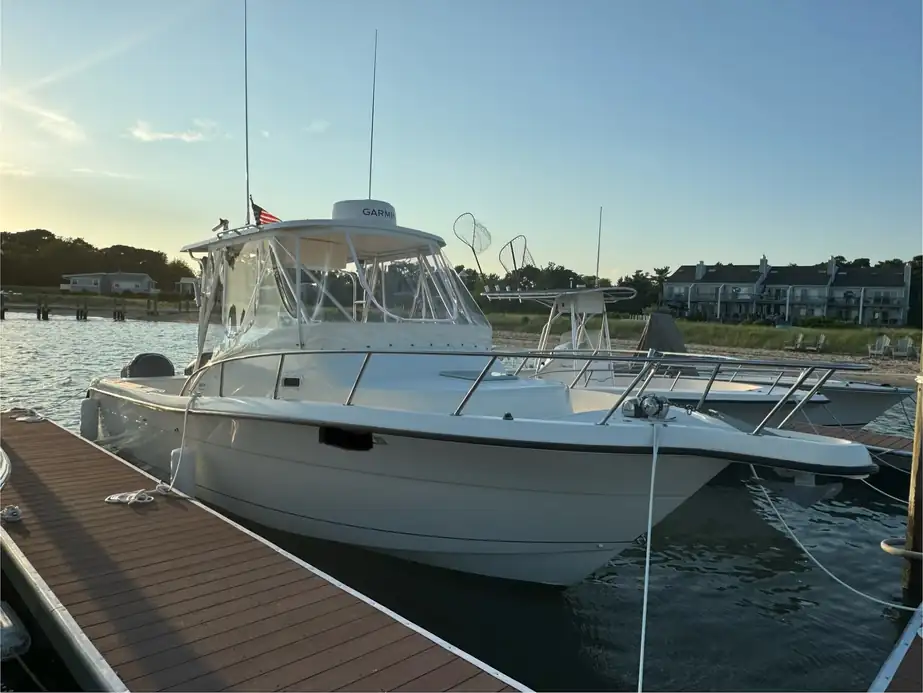
Run your hand over the side of an older white boat and look at your palm. If it comes away with a pale, powdery residue, you're feeling oxidation. It's one of the most common things boat owners ask us about, usually in the spring when the boat comes out from under its cover and looks tired next to the one in the next slip. The good news is that it's fixable. The better news is that once you understand what's happening, you can slow it down.
What gelcoat is, and why it chalks
Most fiberglass boats are finished with gelcoat, a thin resin layer that gives the hull its color and shine. It's tougher than it looks, but it's not permanent. Sun, salt, weather, and years of exposure slowly break down the surface. The top of the layer turns porous and dull, and fine particles of it lift off when you touch it. That's the chalk. The color fades with it, which is why dark hulls and red stripes can look washed out long before white ones do.
Oxidation isn't dirt. You can wash a chalky hull all day and it will still look flat, because the problem is the surface itself. That's where many owners lose a weekend: scrubbing harder, hoping the shine comes back with more effort.
Why wax alone doesn't fix it
Wax over oxidized gelcoat looks fine for a few weeks, then the dullness comes back. The wax is sitting on top of a layer that's already failing, so you've protected the damage instead of removing it. It's a bit like painting over rust. A proper finish starts with taking away the dead layer, so what's left is fresh gelcoat that can actually hold a shine.
What a compound-and-refinish does
Compounding is controlled abrasion. A machine and a cutting compound remove the thin oxidized surface, leaving a smooth layer of healthy gelcoat underneath. Finer polishing steps then bring that surface up to a deep gloss, and a protective finish goes on last to keep the shine from fading back. Each stage leaves the surface smoother than the one before it.
Our version of this is the Y-Paint five-step compound and refinishing process. We won't walk through every stage here, because the exact approach depends on how far gone the gelcoat is and what the boat is made of. A lightly dulled hull needs a different touch than one that hasn't been cut in a decade. What stays the same is the order: clean first, remove the damage, refine the surface, then protect it.
- Cleaning comes first, so the machine isn't grinding dirt into the surface.
- Compounding removes the oxidized layer and levels the surface.
- Refining and polishing bring back depth and clarity in the finish.
- A protective layer goes on last to hold the shine and make washing easier.
Topside, hull, and the rest of the boat
We detail the whole exterior: topsides, hull, and the areas in between. Topside detailing covers what you see from the dock, like decks, cockpit surfaces, and rails. Hull detailing covers the sides down toward the waterline. Boats don't wear evenly. The sun-facing side often looks worse than the shaded one, and horizontal surfaces take more punishment than vertical ones. A good job evens all of that out so the boat looks like one boat again.
How often to wash
Regular washing is what keeps a refinished hull looking that way. Salt dries on the surface, and a boat that lives in the water collects film, growth, and grime week after week. We offer weekly, bi-weekly, and monthly washing options, and the right one depends on how you use the boat.
- Weekly suits boats that are used hard all season, or kept in the water where salt and dirt build up fast.
- Bi-weekly works for boats that get used most weekends and need to look sharp without constant attention.
- Monthly is a reasonable baseline for boats that don't leave the slip much, or sit on a lift.
If you're not sure which fits, tell us how you use the boat and where it lives, and we'll point you to the right schedule. Since our service is mobile, the crew comes to the marina or your driveway, so you don't have to coordinate anything beyond access.
Slowing the next round of oxidation
No finish lasts forever on a boat that lives in the sun, but a few habits stretch it. Rinse salt off when you can. Keep up on washing instead of waiting until the boat looks bad. Cover or store the boat out of direct sun where that's practical. And when the shine starts to fade, deal with it early, while a lighter touch can bring it back.
For a closer look at what we do on the water, see the marine detailing page, or call (631) 466-1739. Estimates are free, and we usually get back to you the same day.
Absolute Detailing Concepts, (631) 466-1739
Call (631) 466-1739More articles
Getting Your Boat Through a Long Island Winter
Shrink wrap turns a boat on stands into a sealed, weatherproof shape, and the details of how it's done decide how your boat looks in April.
Ceramic Coating: Why Paint Correction Comes First
A coating is only as good as the paint beneath it, which is why every package we install begins with correction.