Getting Your Boat Through a Long Island Winter
Shrink wrap turns a boat on stands into a sealed, weatherproof shape, and the details of how it's done decide how your boat looks in April.
October 14, 2026 · 4 min read
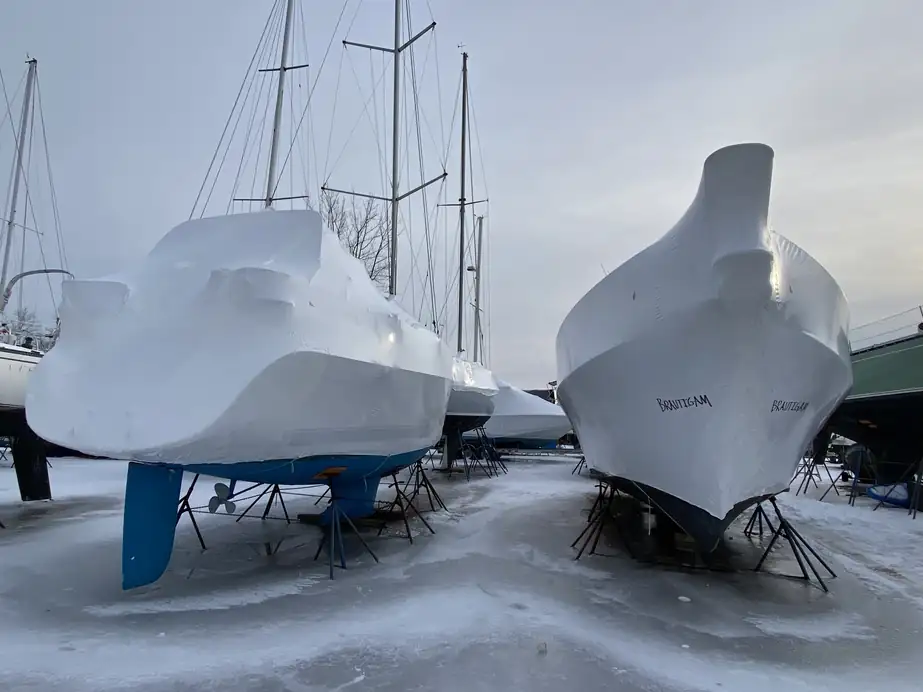
Long Island winters are hard on anything left outside. Freeze and thaw cycles, wet snow, salt in the air that never fully goes away, and wind that comes off the water at full strength. A boat sitting on stands in a yard takes all of it for months, and most of that time nobody is around to see what's happening. If you own a boat out here, the real question isn't whether winter will test it. The question is what stands between your boat and the weather while you're not looking.
What shrink wrap actually does
Shrink wrap is a heavy plastic film that gets pulled over a frame built around your boat, then heated so it tightens into a taut skin. Done properly, it sheds rain and melting snow instead of letting it pool, keeps the wind from working at canvas and fittings, and keeps direct weather off the hull, deck, and cabin. Think of it as a roof and walls built to the exact shape of your boat.
It also does a few quieter jobs. A wrapped boat stays cleaner, because dirt, leaves, and bird droppings land on the film instead of on your topsides. It's very durable when it's installed right. And it reduces the chance of someone tampering with what's underneath, which is a real comfort when the boat sits in a yard or driveway all winter.
Why the film thickness matters
At Absolute Detailing Concepts we use 7 mil film, or stronger. That thickness is a deliberate choice. A thin film can tear at the first sharp corner or the first hard gust, and a tear in January is a leak you won't discover until spring, when the damage is already done. Heavier film stands up to wind, to the weight of snow sliding off, and to the sharp edges every boat has somewhere: rails, cleats, hardtop corners, antenna mounts.
The film is only half of it. The frame under it matters just as much. A good wrap peaks and slopes so water and snow run off the sides instead of sitting on the deck, and the frame keeps the film from resting on gelcoat, where it could rub in the wind. When you look at a wrapped boat in February, you should see clean, tight lines with no sagging pockets. Sagging pockets are where water collects.
Boats are awkward shapes, and that's the point
A cabin cruiser, a center console with a tower, a sport-fisher with outriggers: none of them are boxes. Shrink wrap handles irregular shapes well because it conforms as it tightens. It follows the bow, wraps around radar arches and rails, and pulls snug over odd corners. A tarp thrown over the same boat flaps, chafes, and holds water in every low spot.
That's why we wrap boats of all sizes, from jet skis up to large yachts, and why RVs and campers get the same treatment. If it sits outside and you want it protected, we can generally wrap it. Tell us what you've got and we'll tell you how we'd cover it.
What to do before the wrap goes on
A wrapped boat is a closed space for months. Whatever is inside when we seal it is what you'll open in spring, so the prep counts. Here's the short list we'd give any owner.
- Get the boat clean. Salt, grime, and growth left on the surface don't go dormant over winter, and they're harder to remove in April.
- Take out anything that holds moisture, like cushions, towels, food, and open containers.
- Get the boat as dry as you can before the film goes on.
- Bring loose electronics, canvas, and personal gear home, where it's warm and dry.
- Tell the crew about anything fragile or unusual, like antennas, outriggers, a tower, or a custom rail.
If you'd like the boat detailed before it's covered, we do both jobs. A good cleaning and a protective finish in the fall means you uncover a boat that's still in good shape, not one you have to dig out and start over on.
Storage is the other half
Most homeowners on Long Island don't have much spare room, and a boat on stands can take over a driveway or half a yard. If storage is a problem, and it usually is, we can help move and stack your items in a spot you choose. Once everything is wrapped, it becomes your own outdoor protective storage. That's useful for boats, and it's just as useful for the rest of what lives outside, which we'll get to in another article.
When to book
Book earlier than feels necessary. Everybody on the island wants their boat covered in the same few weeks after haul-out, and wrapping season gets busy. Calling in early fall gets you a date that fits your schedule instead of whatever's left. If your boat comes out of the water in a particular week, tell us when, and we'll work back from there. We're mobile, so we come to you, whether the boat is at a yard or in your driveway.
Estimates are free, and we can usually get one to you the same day. Details are on the shrink wrapping page, or call (631) 466-1739 and tell us what you need covered.
Absolute Detailing Concepts, (631) 466-1739
Call (631) 466-1739More articles
Why Gelcoat Chalks, and What Compounding Does About It
That chalky film on your topsides is oxidation, and the only real fix is to remove it before you protect what's underneath.
Ceramic Coating: Why Paint Correction Comes First
A coating is only as good as the paint beneath it, which is why every package we install begins with correction.